
s01e01: Lasagna Ricorsiva! Layers to the Limit
Recursion & the Stack: A deep dive into memory limits and how one recursive mistake triggered a massive Stack Overflow in The Software Restaurant.

Who is this comic series for?
“If you can’t explain it to the CEO, you don’t understand it yourself.”
Most people think of Recursion as a complex math concept. At The Software Restaurant, it turned out to be a lasagna that defied the laws of physics…
Whether you’re a Junior Dev trying to survive your first technical interview or a CTO trying to explain why the legacy system just hit a Stack Overflow, this episode is for you. Let’s simplify those complex software mechanics through a comic and hopefully, help you build the right mental models.
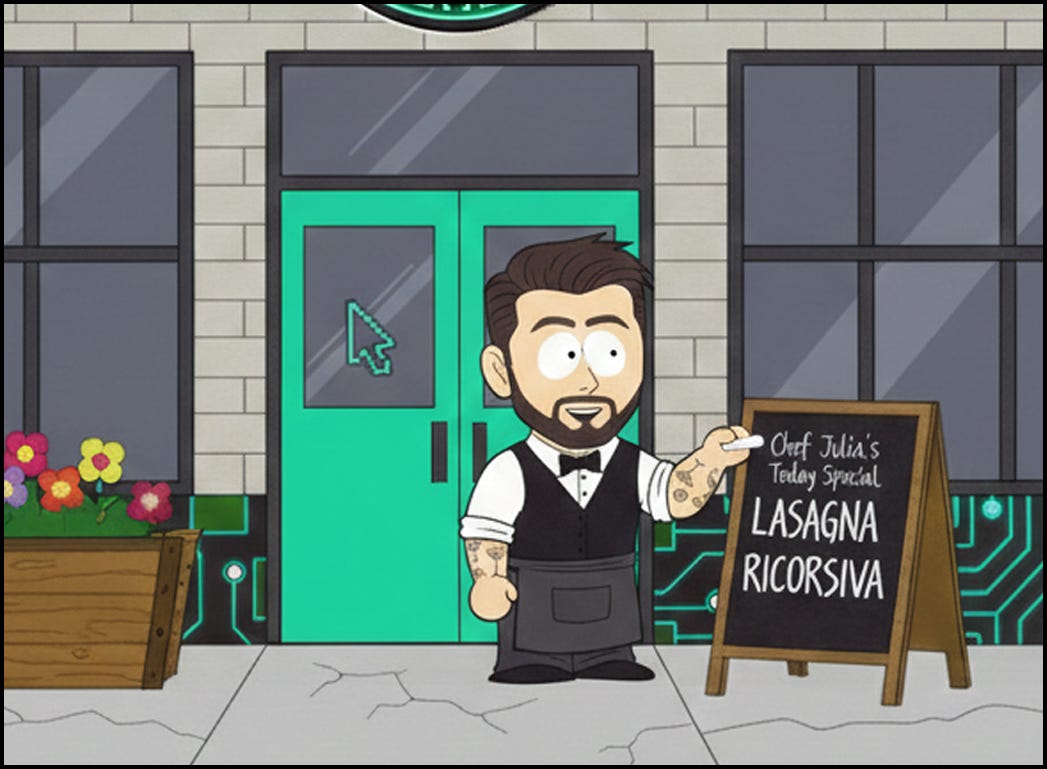
Cody, bartender at 8 bytes! The Software Restaurant: “I was polishing glasses at the bar, getting ready for the Soft Opening and watched from the side the disaster unfold... Julia, our head chef was following the recipe strictly, because she wanted THE PERFECT DISH. But she had an issue with her ”Base Case”. And soon, I realized that the ‘Stack’ wasn’t just full, it was about to blow!
Here is what happend. I’d just written down the Today’s Special on the board outside the restaurant…”
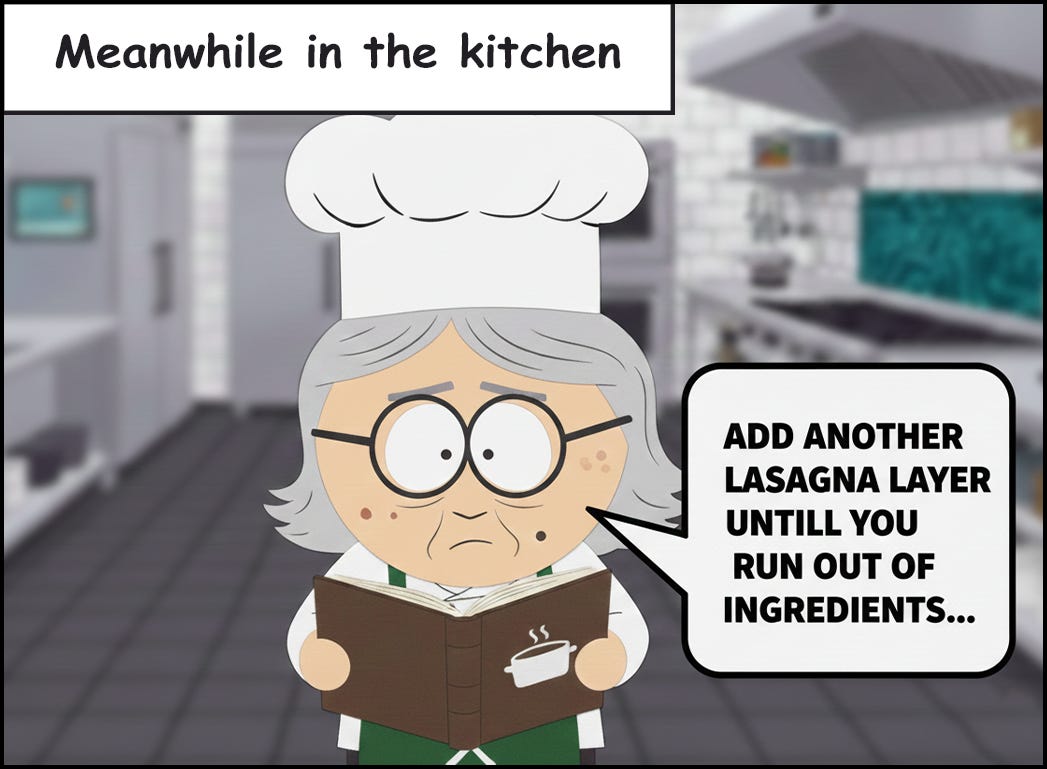
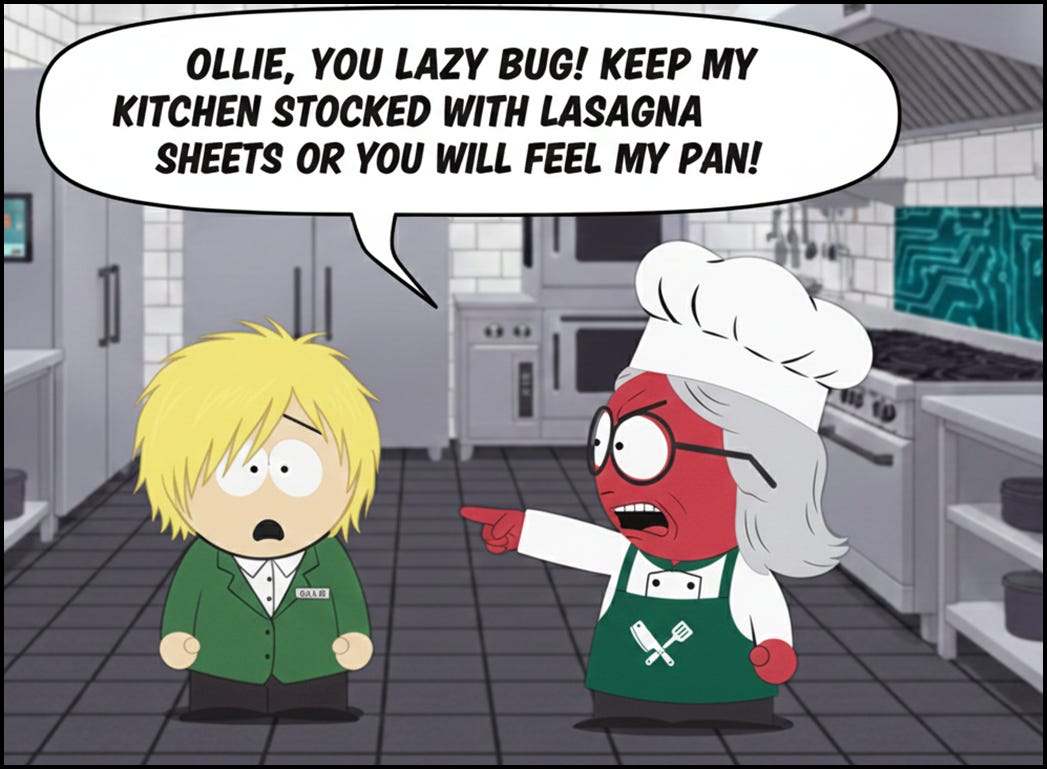
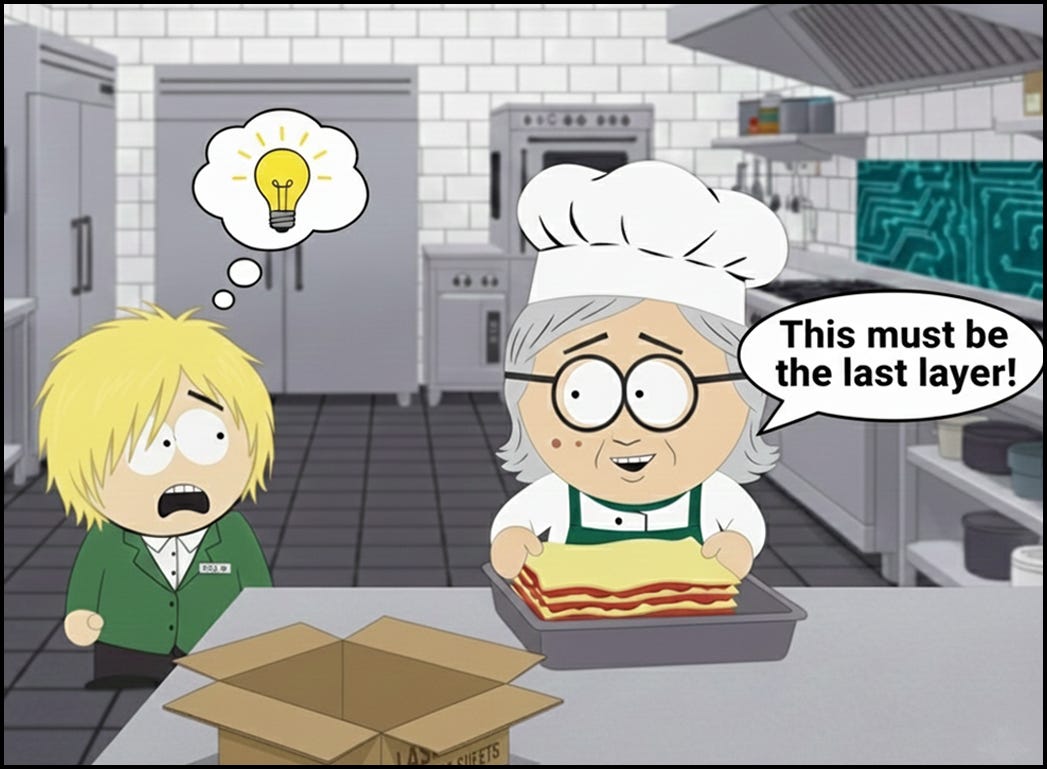
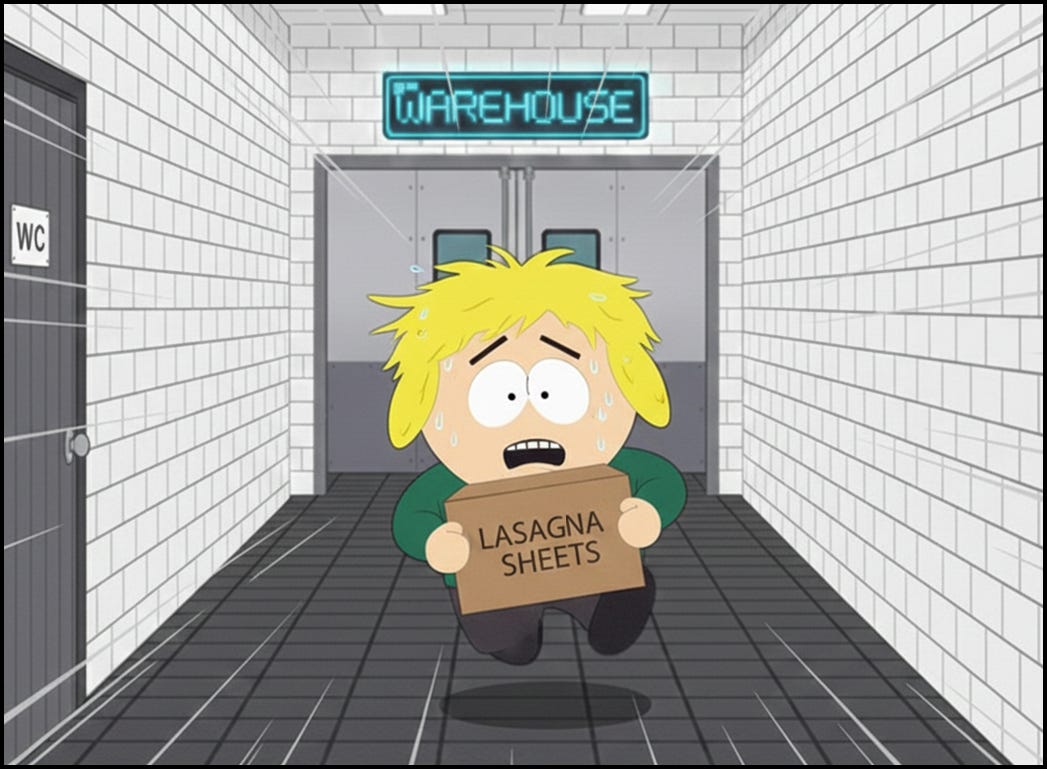
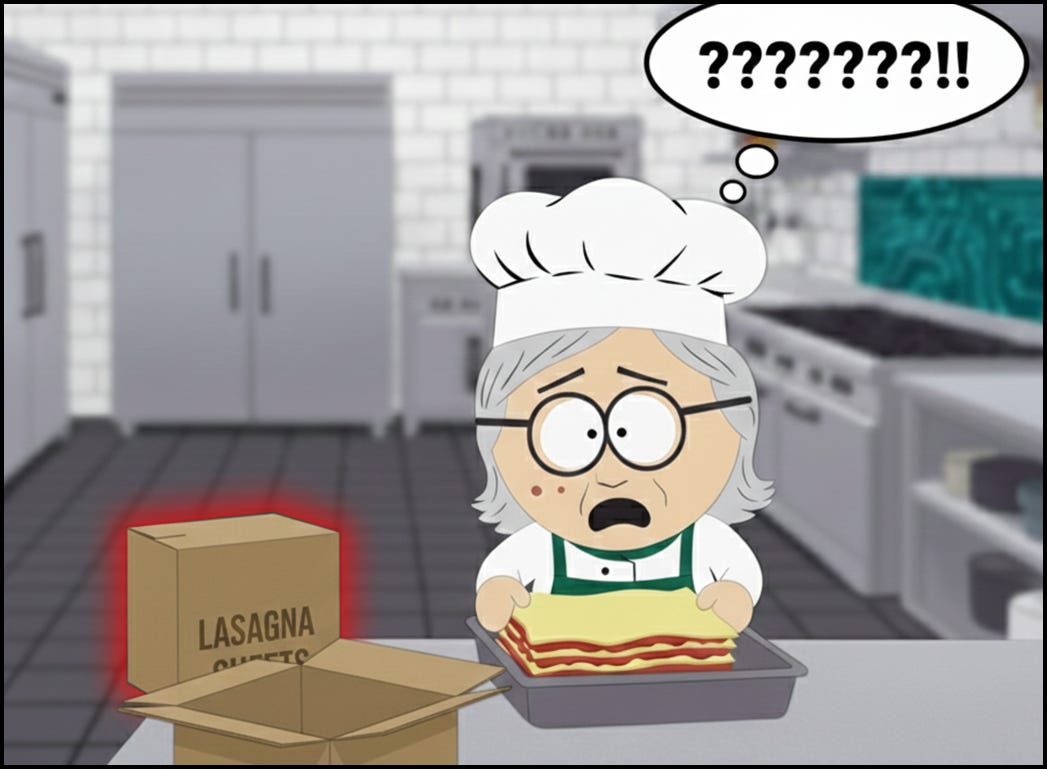
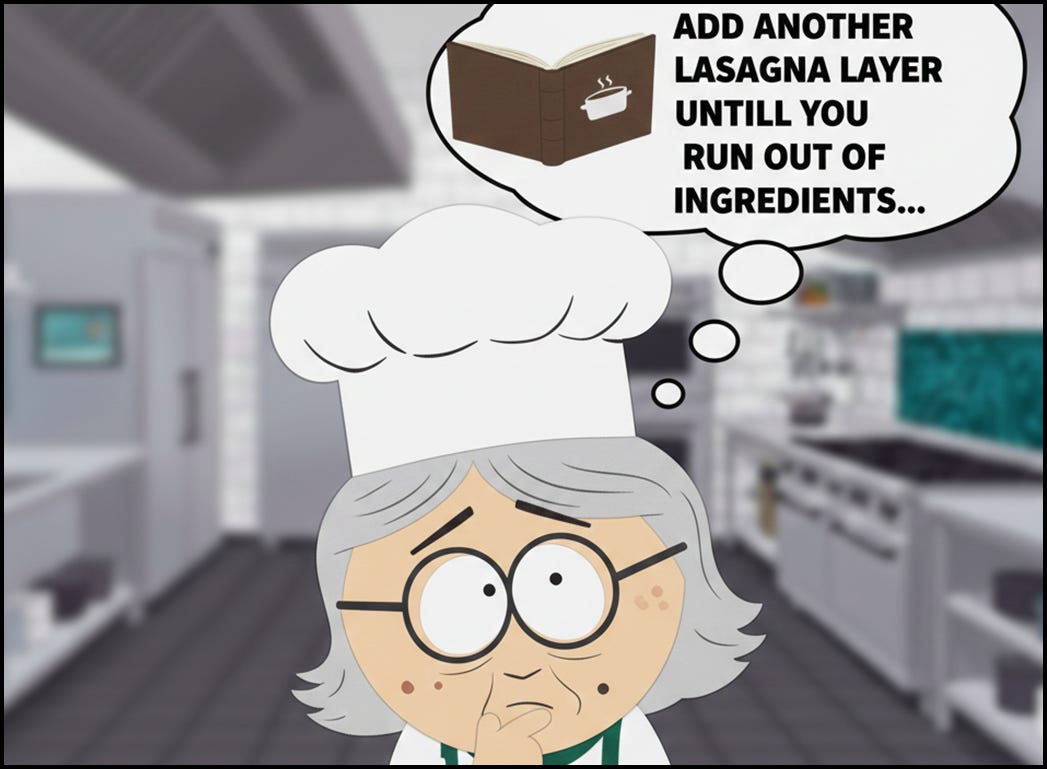
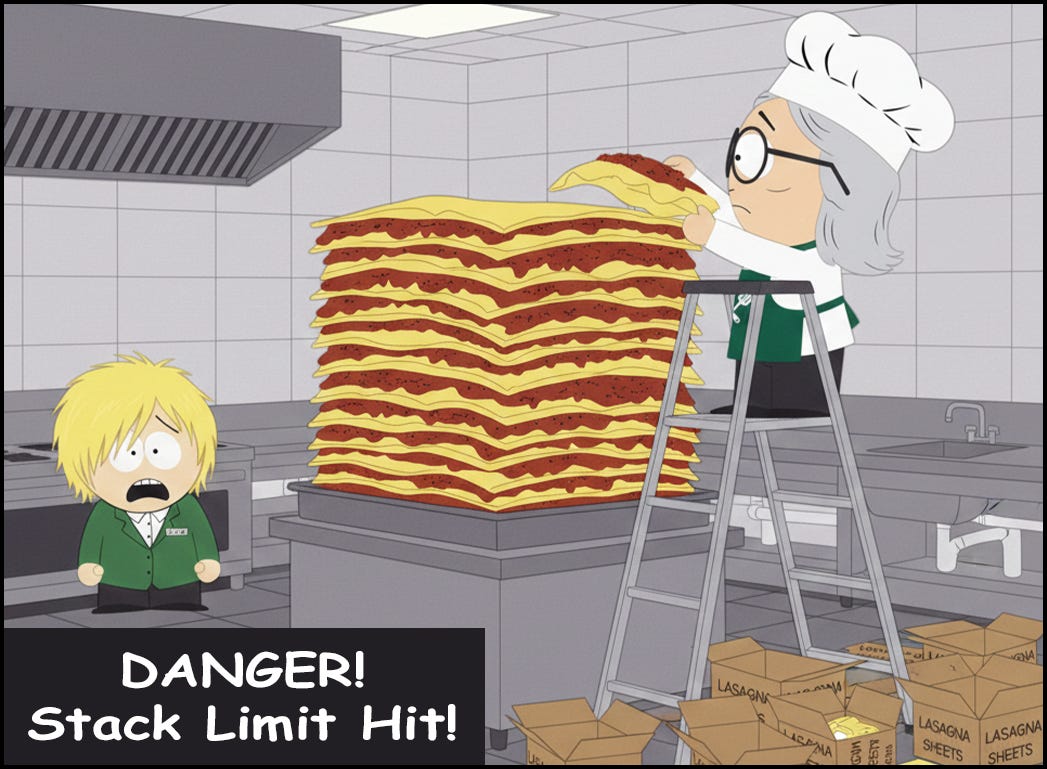
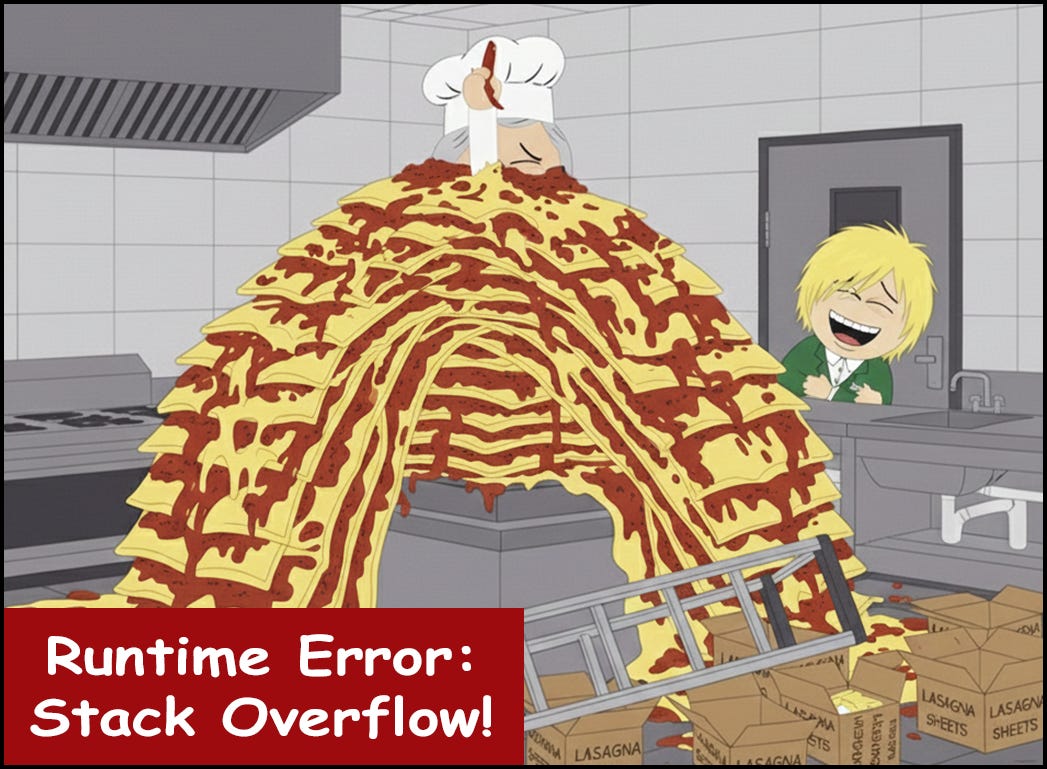

Wait, why did the kitchen actually explode?
🎁 Follows a «FREE PREVIEW» of PAID sections of our 8bytes episodes!
The Stack & the Heap
In software engineering, the Stack is the engine of execution. Unlike the Heap, which is a large, messy pool of memory where you have to hunt for space, the Stack is a strictly managed, lightning-fast segment of RAM.
To picture it - from Julia’s perspective the order tickets spike is the Stack and the restaurant’s warehouse is the Heap:
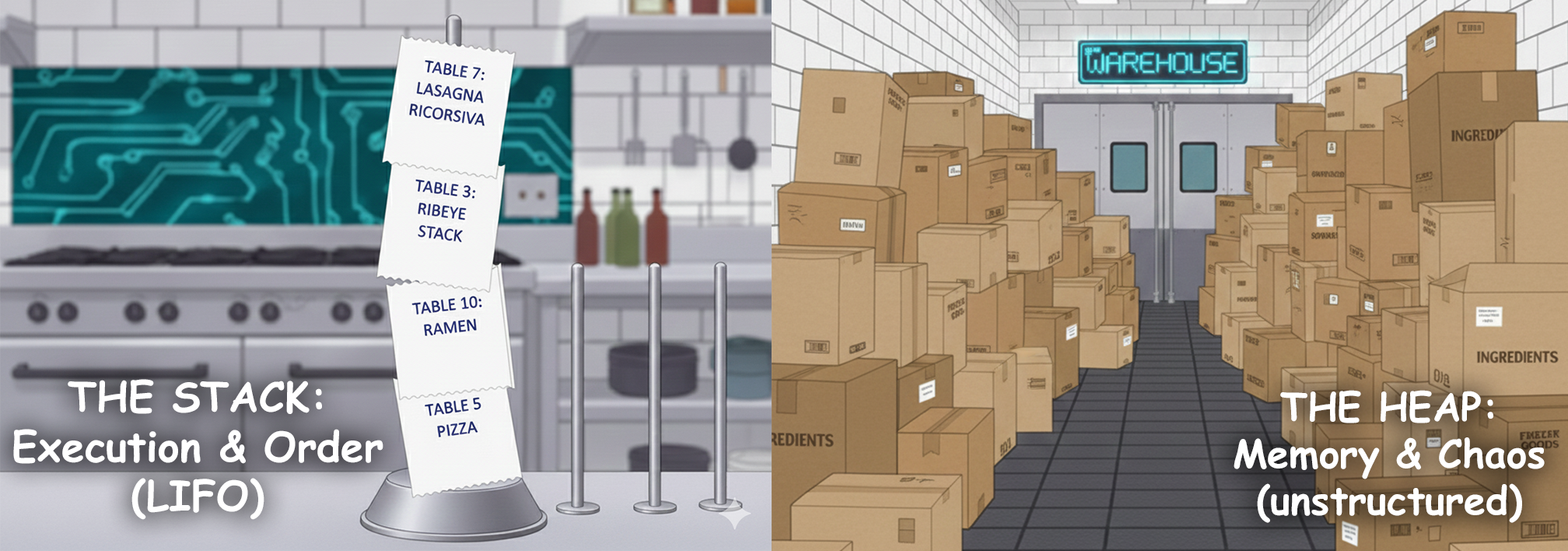
The warehouse is the place you store big objects. It can be very well-organized… or NOT (as you will see in next episodes)! The main issue with the Heap is its accessibility - Ollie has to run all the way down the long corridor to fetch supplies from the warehouse. This travel time is exactly like memory latency - the Heap gives you space, but you pay for it with speed.
The order ticket spike in the kitchen, on the other hand, is a fast-access memory store. The spike is the perfect metaphor for a LIFO (Last-In, First-Out) stack - as you always process the topmost item first.
And what is the Stack Frame?
At the CPU level, the Stack is managed by a special register called the Stack Pointer (SP). Whenever you call a function (poke a new ticket onto the spike), the SP moves to allocate space for a new Stack Frame in the memory (PUSH operation) and whenever the function returns (Julia tears off a ticket) the SP deletes the frame and moves down to older frame (POP operation).
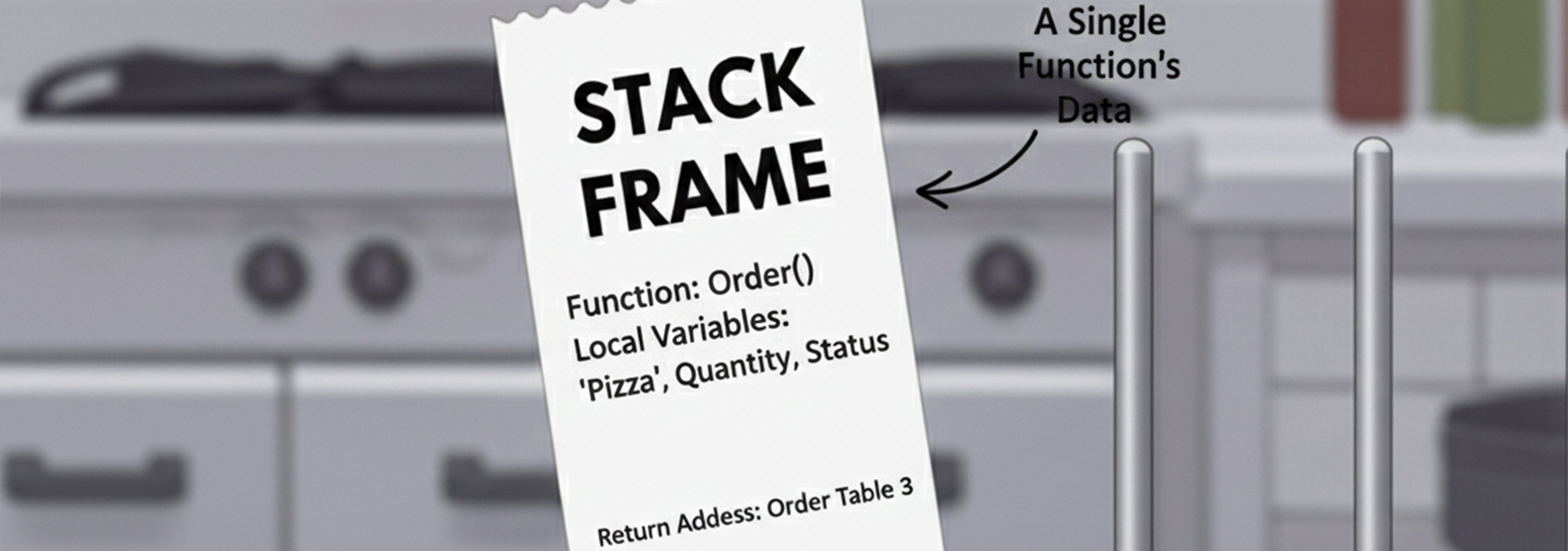
So, practically every Stack Frame is like a single ticket on Julia’s spike created by a table order (a function call). It holds all the local variables of the function. Once the dish is served, the ticket is ripped off and the memory is instantly freed. No leftovers, no mess - unlike the Heap, where things just sit around until someone like the Garbage Collector eventually cleans them up.
The Call Stack - why code execution uses LIFO?
LIFO stack is incredibly Cache-Friendly. Because the data is stored contiguously, it often stays inside the CPU’s L1/L2 cache, making it thousands of times faster than fetching data from the Heap. All it takes for Julia is to reach out and tear off a ticket.
LIFO is the perfect fit for code flow execution as programs by themselves are practically a set of nested instructions (functions) and the execution context navigates deeply through these functions until they return, before it continue with the “parent” context all the way back to the main() block. In other words - the program is like a lasagna eaten layer after layer at runtime.
Recursion vs. Iteration: How they use the Stack?
There are two ways to build our lasagna - using recursion or using a while loop and in either solution your Base Case is the most critical ingredient. But there is a huge difference on how your code will use the Stack in both scenarios.
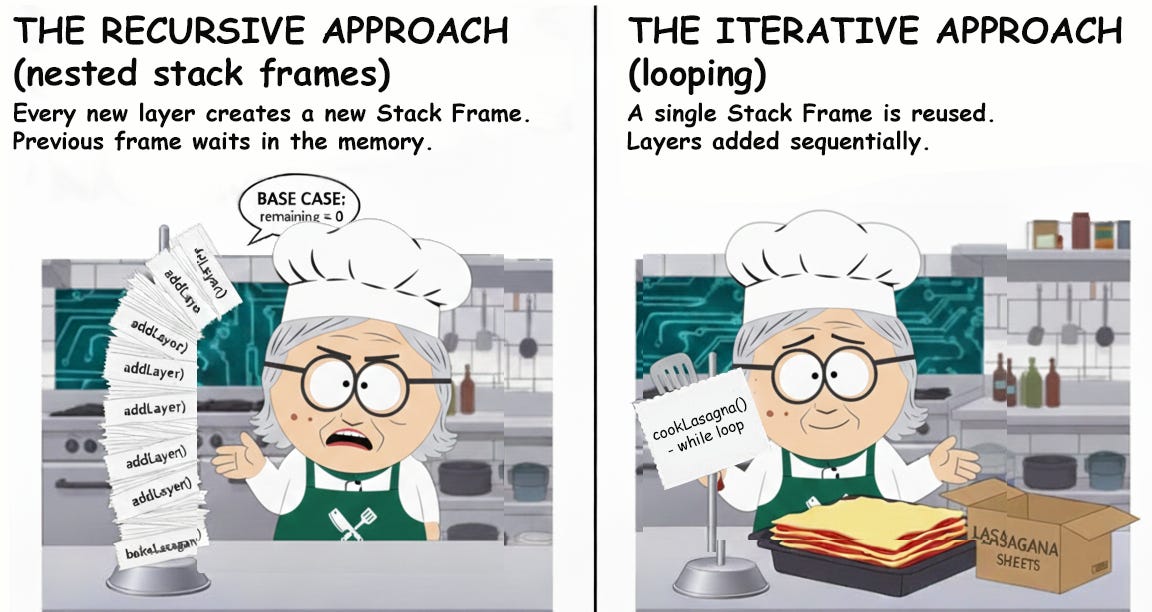
A. The Recursive Approach (Nested Stack Frames)
In recursion, every new layer creates a new Stack Frame. The previous frame stays in memory, “waiting” for the top one to finish. Imagine it like if Julia had tickets on the spike for every operation she does. Our code goes like this (dummy Java sample):
1  // Starts the process (a note on the bottom of the spike)
2  void bakeLasagna(int layers) {
3      addLayer(layers); // poking second note onto the spike.
4  }
5
6  void addLayer(int remaining) {
7      // BASE CASE: The bottom of the tray
8      if (remaining <= 0) {
9          return;
10     }
11
12     // RECURSIVE STEP: Poking a new ticket onto the spike
13     addLayer(remaining - 1); // new Stack Frame is created
14 }
What is happening here?
bakeLasagna is the first ticket: It sits at the very bottom of the spike. It is the main() function that stays in memory and “holds” the entire operation together until everything else is finished.
every addLayer is a new ticket: Each time the function calls itself, a new ticket is poked onto the top of the spike (PUSH operation).
the Base Case (remaining == 0): When Julia reaches the bottom of the tray, she stops poking new tickets. This is our Base Case.
unwinding the Stack: Julia (our CPU) then starts completing the tasks removing the tickets one by one from top to bottom (POP operation). She can only get back to the original bakeLasagna ticket once every single layer above it has been cleared.
The fact that the recursion code allocates new frame for every step is dangourous! If the recursion goes too deep, there won’t be any room left for new ‘tickets’ on the spike. That is why in every programming language, there is some sort of a built-in limit on recursion depth as a safety measure to prevent your function from from consuming all the available stack memory and crashing the entire system:
Java - it is dynamic (usually ~1,000 to 10,000 calls), it depends on the -Xss (thread stack size) setting. Once reached, it throws a StackOverflowError.
Python - typically 1,000; Python is very conservative, if you hit the limit, it throws a RecursionError. You can check it with sys.getrecursionlimit().
C# - dynamic (based on stack size) and similar to Java, it depends on the stack size of the thread (usually 1MB on 64-bit). It throws a StackOverflowException.
B. The Iterative Approach (Single Frame Efficiency)
If we change the implementation with an iterative approach, instead of poking many tickets (frames) onto the spike, Julia uses one single ticket and just updates the numbers on it until she's done. The same way a while loop normally creates a single stack frame and it simply updates the values (the state) inside that same memory space over and over.
1  void bakeLasagnaIterative(int layers) {
2      int currentLayer = layers;
3
4      // The loop handles everything within a single Stack Frame
5      while (currentLayer > 0) {
6          System.out.println("Adding layer...");
7
8          // We just update a local variable
9          currentLayer--;
10     }
11 }
As the code shows, you are not calling a function inside the loop, therefore, no new stack frames are created. This makes the iterative approach significantly more memory-efficient.
So, should you ditch recursion for a while loop every time?
Absolutely not!
First: Recursion is your best ‘chef’s knife’ for traversing hierarchical structures like a nested file system or organization chart. It’s simply cleaner to implement.
Second: While loop by itself doesn’t keep you safe. A poorly defined stop condition is equally disastrous for both recursion and a while loop. You won’t overflow the stack this time, but you’ll certainly serve up a Lasagna Infinita - the dreaded infinite loop.
Explain!
We have a single Stack Frame and on each iteration Julia is furiously erasing and rewriting the last line on the same piece of paper. With a bad Base Case, the tickets count on the spike stays the same (Thank Lord!), so the Stack remains in perfect shape.
Your Memory (the Heap) will also be fine, unless within the loop we start piling up massive objects. It’s like if Julia, instead of just erasing and rewriting lines on the small ticket, decides to turn it to a bible-sized novel.
Your CPU, however, will be sizzling at 100% like Julia’s pan! It’s the perfect recipe for a system freeze.
The Architect’s CEO translation guide
Once in a while, you probably had to explain to non-technical boss what is happening with their application - why it doesn’t work and they are losing money, and how are you going to fix it. Yes, I know! They will most certainly also ask you when will the fix be in prod and how much will it cost, but I’ll leave that one for you!
What I can help you with, however, is to build a soft skill of crafting the “metaphor”. The metaphor is the most powerful tool in your belt. When you talk about “LIFO stacks,” you risk losing your audience. But when you talk about a kitchen process, everyone - from the CEO to the junior dev will most probably get it.
1. Stack vs. Heap - The Speed Factor
The Metaphor: The Stack is the order spike next to the stove - fast and organized. The Heap is the big warehouse down the corridor - tons of space, but you need a map (a pointer) to find anything.
Why it matters: Accessing the warehouse takes time; using the spike is instant.
2. Thread Safety - The Multiple Chefs
The Metaphor: Every “Thread” (Chef) gets their own private order spike. Chef A never touches Chef B’s tickets. This is why local variables are naturally Thread-Safe.
3. The Stack Overflow: The Ceiling Limit
The Metaphor: If the chef never hits the “Base Case” (the bottom of the tray), they keep adding tickets until the spike hits the ceiling. There’s no more room to store info, so yout kitchen is practically blown.
4. Function Returns: Clearing the Spike
The Metaphor: When a function returns, the ticket is ripped off the spike. The space is instantly ready for the next order. No cleaning required!
Famous failures
Apple Image I/O (2021/2022): The “Infinity Image” Crash
Back in 2021, a critical vulnerability was discovered in Apple’s Image I/O framework, which handles how iPhones and Macs process image metadata. A specially crafted image file (like a TIFF or GIF) could contain maliciously nested metadata tags. When the system tried to parse these tags, the parsing function called itself recursively for every nested layer. Since there was no limit to this depth, it caused a classic Stack Overflow. Simply previewing the image in a browser or receiving it via iMessage was enough to crash the app.
Lesson learned: Even “read-only” operations like parsing an image can be dangerous if the code uses unbounded recursion on untrusted data.
Read more: Project Zero: ForcedEntry - NSO Group’s iMessage Zero-Click Exploit
Google V8 & Node.js (Multiple years): The “Russian Doll” JSON Attack
Parsing text (be it XML or JSON) as structured data is one of the most common vectors through which a lot of problems might be triggered in a system. Most parsers use Recursion to navigate through the data as data structures are not always flat. If a malicious user sends a JSON file with 50,000 nested brackets [[[[...]]]], the parser calls its internal function recursively for every new layer. Each layer adds a new “ticket” (Stack Frame) to the spike. Even high-end engines like Google’s V8 have been vulnerable to this, leading to instant crashes of browser tabs or backend servers.
Lesson learned: Never trust user input and always set a max depth limit in your code.
Read more: V8 JSON.parse Stack Overflow Issue
Closing Time
Cody, the bartender: “Ollie is still cleaning up the mess in the kitchen, while Julia is already rewriting the ‘logic’ for tomorrow’s service.
But let’s see how things will play out next time. Our boss Nina Glamour is preparing the restaurant for the Grand Opening, but eventually she will learn the hard way that LIFO stack, while perfect for program code execution, does not fit for everything…
Get ready for Episode 2 and remember! Always be careful with your Base Case!
Cheers.”
Bonus content: download the episode comic:

☕Or buy me coffee (one-time tip)
No tip today?! No worries, just sharing my story will be most appreciated. Thanks!
Illustration credits: Comic scenes conceptualized by 8bytes and rendered by Nano Banana.