

« Prev Snack | No next yet
Category: 8bytes! The Restaurant
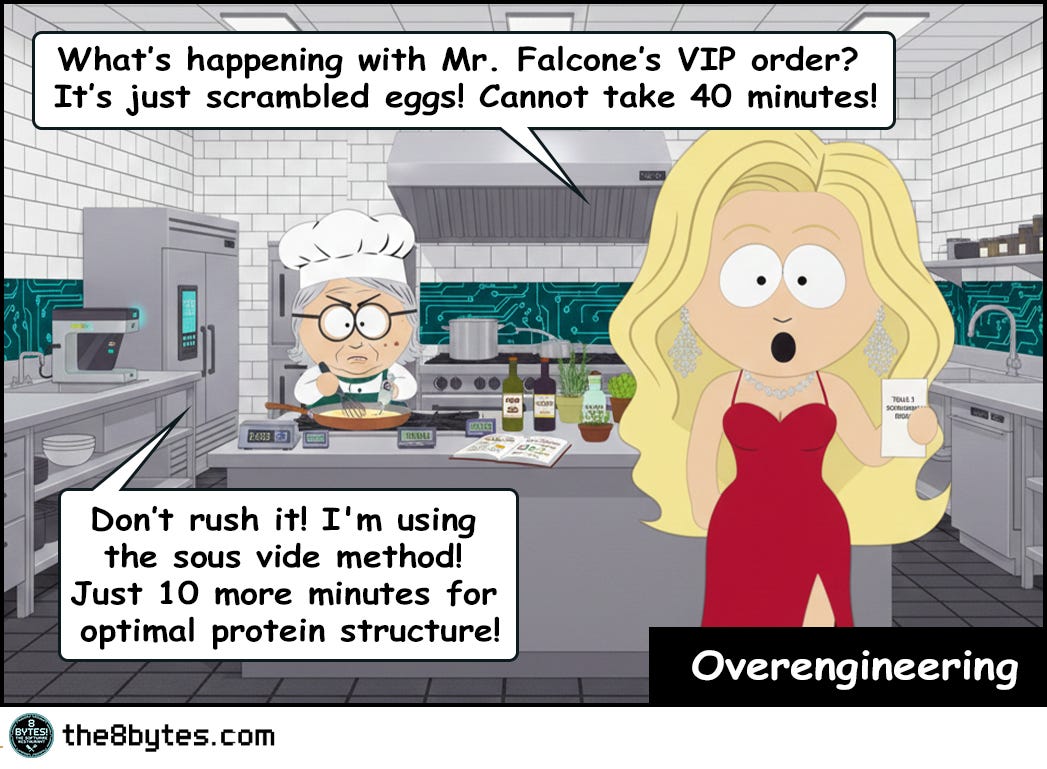
Jack Falcone left 20 minutes ago…
The eggs were perfect, but nobody was there to eat them.
Welcome to Overengineering
We’ve all been Julia. Spending 50 minutes to make “perfect” scrambled eggs when good eggs take 3 minutes. Building elaborate systems for problems we don’t have yet. Optimizing for scale we’ll never reach.
The perfectionist’s curse: We confuse complexity with quality.
What Julia’s Kitchen Teaches Us
Julia used sous vide machine for precise temperature control, digital thermometer, pH meter, $200 copper pan, precision scale (to the gram), truffle oil, gold leaf garnish, multiple timers (millisecond precision!).
Time: 50 minutes
Cost: $47 in ingredients and equipment
Customer satisfaction: 0 (they left)
What was actually needed - Regular pan. Butter. Salt. Pepper. Full stop.
Time: 3 minutes
Cost: $2
Customer satisfaction: High (if they’d stayed)
The Software Development Reflection?
Overengineered:
Distributed event-sourcing system
CQRS pattern
Kafka for event streaming
Cassandra for write scaling
Redis for caching
Elasticsearch for queries
Custom consistency resolver
Team size needed: 15+ engineers
Learning curve: 6 months
Can handle: Billions of events
Good enough:
Postgres with good indexes
Maybe Redis for hot data
Backups automated
Team size needed: 2 engineers
Learning curve: 1 week
Can handle: Millions of records (which is all you need)
Why We Overengineer
Perfectionism Feels Like Professionalism
“If I don’t use the latest tech, am I even a real engineer?”
Yes. You are. Building things that work makes you a real engineer. Using every tool in the toolbox makes you exhausted.
Resume-Driven Development
“I need Kubernetes experience for my next job!”
Great. But your current startup with 100 users doesn’t need Kubernetes. Your resume will survive without it. Your startup might not survive with it.
Fear of Criticism
“Someone might say my solution is ‘too simple.’”
You know what’s worse than “too simple”?, “Doesn’t work” and “Never shipped.”
Solving Tomorrow’s Problems Today
“We might need to scale to 1 million users!”
You have 47 users. Build for 47 users. When you have 47,000 users, then optimize (Spoiler: If you overengineer now, you’ll never get to 47,000.)
The Illusion of Control
Complex systems feel controllable because we built them. Simple systems feel risky because we didn’t build everything. This is backwards. Complex systems have more failure modes. Simple systems are easier to fix when they break.
When Perfection Actually Matters
Don’t get me wrong - sometimes precision is critical.
Build for perfection when:
Medical device software (lives at stake)
Financial transactions (money at stake)
Aviation systems (lives at stake)
Nuclear reactor controls (many lives at stake)
Security infrastructure (data at stake)
Don’t build for perfection when:
Internal tool for 5 people
MVP testing product-market fit
Side project you’re learning from
Scrambled eggs for lunch
90% of software projects
The Real Kicker
Simple solutions are often better - faster to build, easier to maintain, lower probability to fail, actually get used as customers gets real value fast. Don’t believe me?
Julia’s 3-minute scrambled eggs? Customer loved them.
Julia’s 50-minute perfect eggs? Customer never saw them.
The Cost of Overengineering
Four words: Time. Money. Opportunity. Simplicity.
It takes 50 minutes to finish a task instead of 3 minutes. Market reach for new functionalities take weeks or months instead of days. And all this requires a lot more money for engineers, tools, infrastructure and licensing costs, money that may never repay. Customers leaving before seeing the new feature, always behind faster shipping competitors (“But! Their services are awful, we are going to make it a lot better, right?!”). Losing market share. Team burned out. People lost… Onboarding of new team members becomes very hard because of the steep learning curve.
My Confession
I’ve been Julia. Many times. (even now when I try to simplify this article for the 10th time 😳). So always try to think whether simple scramble eggs would fill the tummy. Ask yourself:
“Will simple work?” (Probably yes)
“Do we have this problem NOW?” (Probably no)
“Can we buy a solution?” (Probably yes, and it’s cheaper)
“Will the customer care?” (Probably no)
“Will this help us ship faster?” (Definitely no)
And most of the time it seems perfect can wait.
Cheers!
Miro - The TechMetaphorist
P.S. Julia eventually learned. Now she makes scrambled eggs in 3 minutes. They’re good enough. Customers love them. And Jack came back.
P.P.S. She still has the sous vide machine. But it’s in the storage. Just in case she ever needs truly optimal protein structure. (She won’t.)
Want More Software Stories?
This Snack is part of the 8bytes! The Software Restaurant newsletter, where complex tech concepts become digestible stories.
Here I serve:
🍕 Full comic episodes (bi-weekly)
🥨 Quick Snacks like this one
Tech stories that even your grandma can understand (and your manager will pay for).
Illustration credits: Comic scenes conceptualized by 8bytes! and rendered by Nano Banana.